
Make
Something
for Fall
One beautiful project worth getting the table messy for.
There comes a point every fall when buying another pumpkin starts to feel like a failure of imagination.
We have pumpkins.
The pumpkins are doing excellent work.
Perhaps we could contribute something.
So pull out the scissors, find a handful of leaves worth keeping, and clear a little space on the table.
We’re making something.
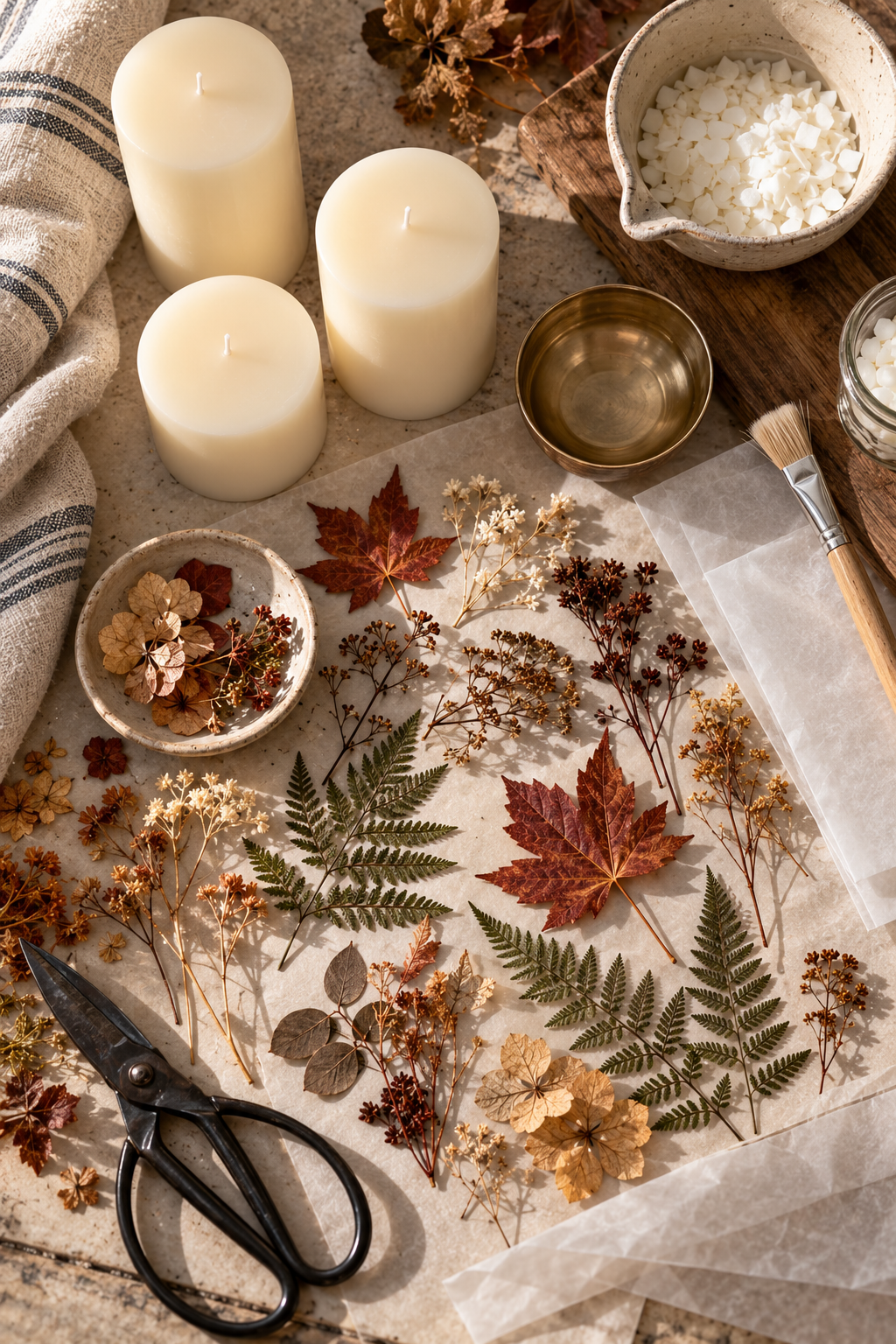
Pressed Botanical Candles
The grown-up version of a fall craft.
Beautiful enough for the mantel.
Easy enough to make in an afternoon.
And restrained enough that your house will not suddenly believe it is a craft store.
These are simple ivory pillar candles wrapped in pressed leaves, ferns and tiny dried flowers, then sealed with a whisper-thin layer of wax.
They are imperfect.
They are one of a kind.
And when someone asks where you bought them, you get to say:
I made them.
Which is at least half the point.
What You’ll Need
- Ivory pillar candles
- Pressed leaves, ferns or dried flowers
- Plain candle wax or an inexpensive ivory candle to melt
- A small heat-safe bowl or pouring vessel
- A small saucepan for a gentle double boiler
- A soft paintbrush
- Wax paper
- Scissors
- Tweezers, optional
And approximately thirty minutes in which nobody asks where their charger is.
Choose the Good Ones
This is where restraint begins.
Look for botanicals with interesting shapes rather than simply collecting everything that has fallen from a tree.
- A tiny fern.
- One beautifully colored leaf.
- A delicate stem of dried flowers.
- Something wispy.
- Something slightly imperfect.
You are not recreating the forest.
You’re editing it.
Three botanicals.
Then walk away.
The fourth leaf is where confidence becomes a theme.
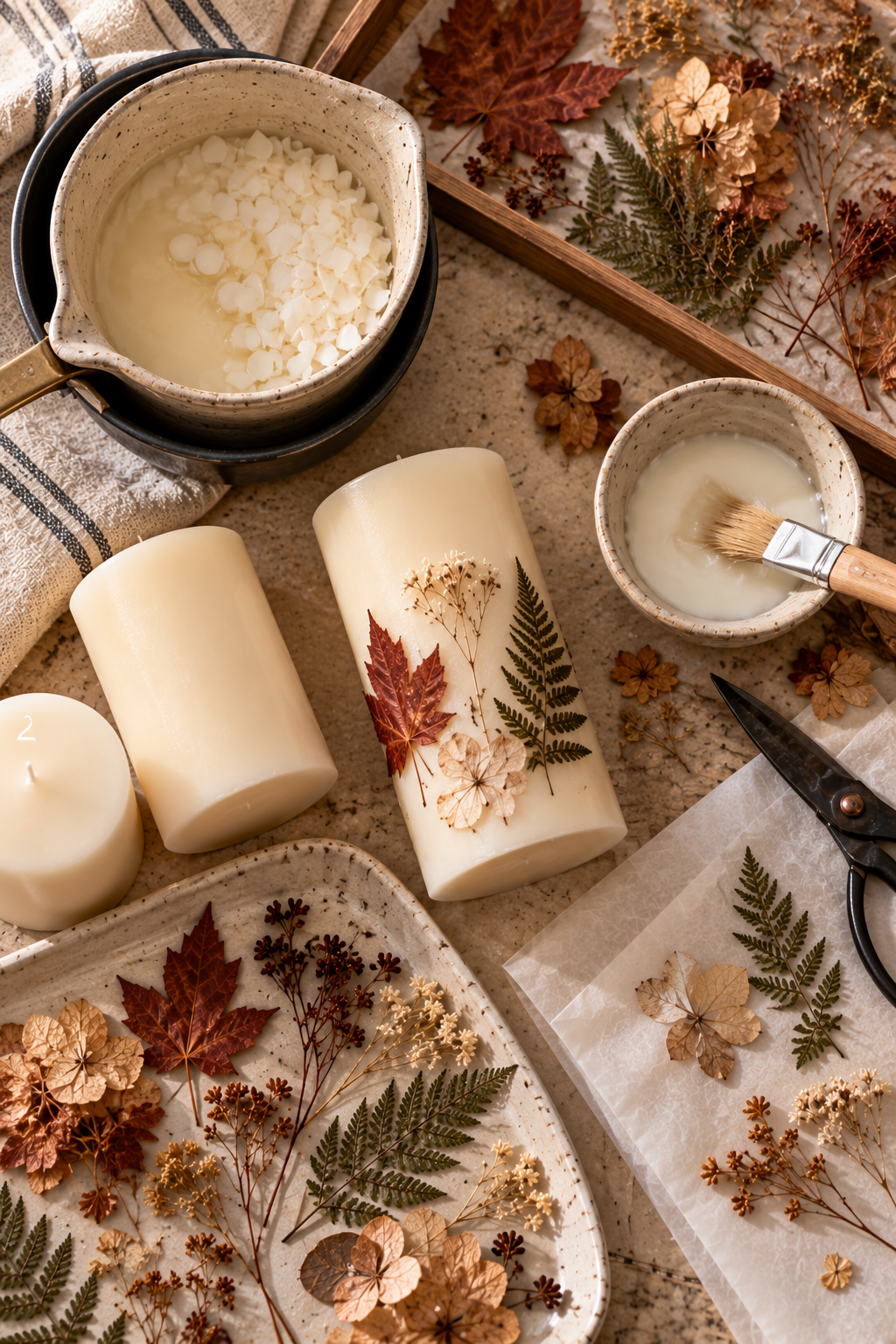
Melt a Little Wax
You do not need much.
Place a small amount of plain candle wax in a heat-safe vessel and melt it gently using a double boiler.
Keep the heat low.
Once the wax is completely melted, remove it from the heat and bring it over to your work surface.
This is not candle-making.
We are borrowing just enough wax to make the leaves stay put.
A little is plenty.
Plan Before You Commit
Lay the candle on its side.
Arrange your botanicals against it without wax first.
Move them around. Turn a leaf. Remove something. Put it back. Remove it again.
This tiny bit of indecision is doing important work.
Try one taller element with something small beside it, or let a single beautiful leaf do most of the talking.
Leave some candle showing.
White space is also decoration.
Place + Brush
Once you like the arrangement, hold the first botanical gently against the candle.
Dip your brush into the melted wax and brush a very thin layer over the botanical.
Start in the center and work toward the edges.
The warm wax will soften slightly against the candle and begin holding everything in place.
Add the remaining botanicals one at a time.
Slowly.
There is no prize for finishing first.
There may, however, be consequences for aggressively brushing a fern.
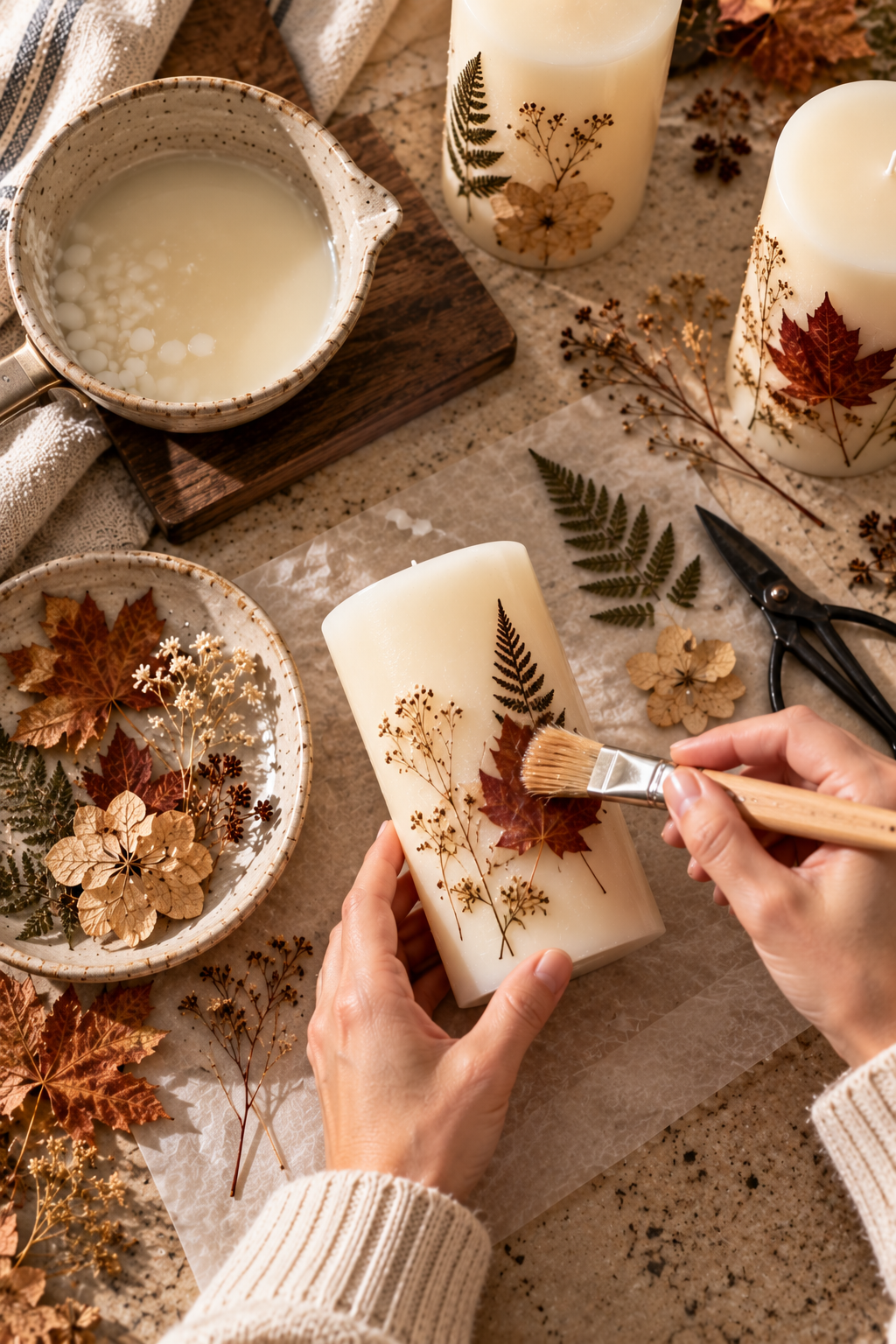
Smooth It Out
If an edge needs a little help, place a piece of wax paper over it and gently smooth the botanical against the candle with your fingers.
Peel the paper away.
Add another whisper of wax only where needed.
You’re looking for the botanical to feel like it belongs in the surface rather than sitting under a thick coating.
A few irregularities are good.
They are evidence that this was made by a person.
Perfect is not the assignment.
Know When You’re Done
This may be the most advanced step.
Stop.
Put down the fern.
Back away from the tiny dried flower.
Look at the candle from across the table.
If your first thought is,
Maybe just one more…
you are almost certainly finished.
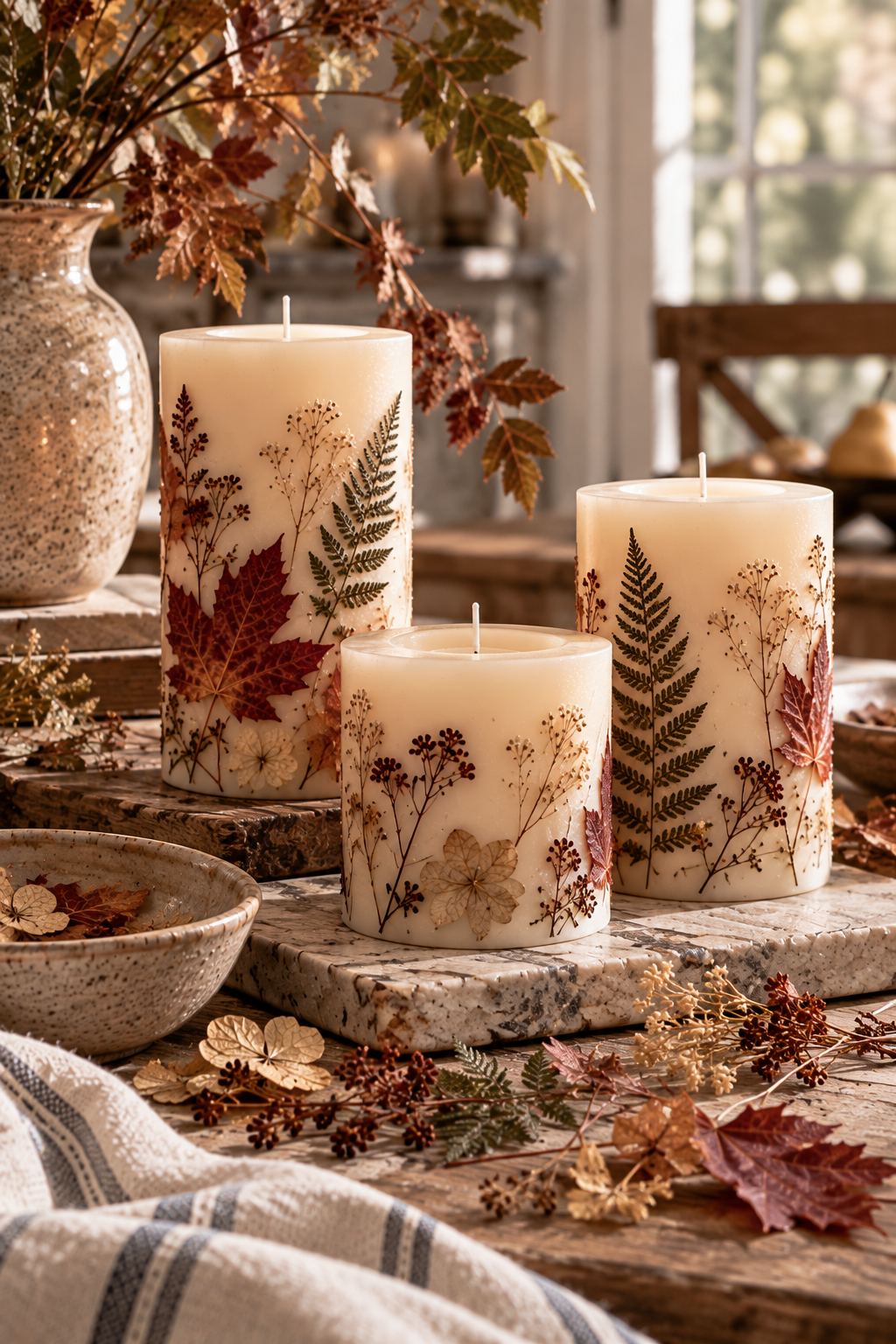
Now Make Another One
Don’t make them match.
That’s what makes a grouping interesting.
Give one candle a single dramatic leaf.
Let another have a delicate fern and tiny flowers.
Keep the third especially simple.
Different heights help too.
Three candles that belong together are much more interesting than three candles trying to be identical.
Put Them Somewhere Good
- A mantel.
- An entry table.
- The middle of the dining table.
- Beside a stack of books.
- On the kitchen counter where you will repeatedly congratulate yourself for making them.
Mix them with things you already have rather than building an entire “fall display.”
A branch from outside. A bowl of pears. A little pottery. Linen.
Done.
You don’t need to redecorate the house every time the calendar changes.
Sometimes one small thing is enough to tell a room:
A new season is here.
There is something satisfying about making a thing that didn’t need to be made.
No one required botanical candles.
The house would have continued functioning perfectly well without them.
But an ordinary afternoon became a little more interesting.
The table got messy.
Something beautiful came out of it.
And now there’s a small reminder sitting on the shelf that says:
I made that.
Maybe that’s reason enough.
Make something anyway.